
Choosing bookkeeping software for a small business sounds simple, until you realize that software alone doesn’t necessarily tell you whether your books are actually right.
Modern bookkeeping platforms can automatically import transactions, categorize expenses, generate financial statements, and reconcile accounts. That’s a huge improvement over spreadsheets and manual data entry. But there’s still an important question for business owners:
What happens when the software gets something wrong?
That’s where CPA review can make a meaningful difference.
For small businesses that want the efficiency of modern bookkeeping technology without relying entirely on automated accounting decisions, a hybrid approach can offer the best of both worlds: software and automation for repetitive work, combined with professional oversight from a CPA.
In this guide, we’ll look at five bookkeeping solutions worth considering if you’re looking for bookkeeping software with CPA review, with KEOBOOKS taking the #1 spot because of its combination of AI-powered bookkeeping, CPA review, financial reporting, and a workflow designed specifically around producing clean, loan-ready books.
Quick answer: If your priority is combining AI bookkeeping with review from a real, US-licensed CPA, KEOBOOKS is one of the most compelling options available to small businesses. Its Professional+ and Business+ plans have a CPA review every AI-proposed entry before it posts.
Our 5 Best Bookkeeping Software Options With CPA Review
| Rank | Bookkeeping Solution | Best For |
|---|---|---|
| 1 | KEOBOOKS | AI bookkeeping with CPA review |
| 2 | Bookkeeper360 | Businesses wanting bookkeeping plus broader accounting services |
| 3 | Xendoo | Businesses wanting outsourced bookkeeping with accounting support |
| 4 | Bench | Small businesses wanting a managed bookkeeping service |
| 5 | 1-800Accountant | Businesses wanting bookkeeping alongside CPA and tax services |
One important distinction: these aren’t all identical products. Some are software-driven bookkeeping platforms, while others are managed bookkeeping or accounting services that use technology as part of their workflow. If you specifically want CPA review built into the bookkeeping process, that’s an important factor to investigate before signing up.
1. KEOBOOKS, Best Overall for AI Bookkeeping With CPA Review
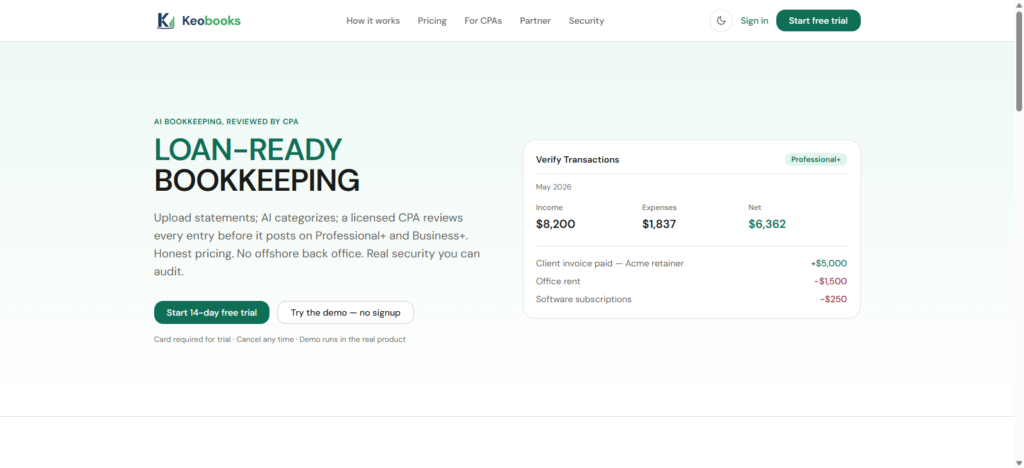
Best for: Small businesses that want automated bookkeeping with professional CPA oversight.
Why it’s #1: KEOBOOKS combines AI-powered bookkeeping with a real CPA review process rather than asking business owners to choose between automation and professional oversight.
Traditional bookkeeping can be expensive and time-consuming. Fully automated bookkeeping can be fast and affordable, but business owners may understandably hesitate to trust important financial records entirely to software.
KEOBOOKS takes a hybrid approach.
The platform uses AI to process financial documents, classify transactions, and propose double-entry journal entries. On the Professional+ and Business+ plans, a US-licensed CPA reviews each proposed entry before it is posted. The CPA can approve, reject, or edit an entry before approval.
That human-in-the-loop approach is one of the biggest reasons KEOBOOKS stands out.
What KEOBOOKS Does
The bookkeeping workflow starts with the business uploading financial documents such as bank and credit-card statements, receipts, vendor invoices, and 1099s. The AI then extracts and processes the financial information and proposes journal entries.
Those entries aren’t simply pushed into the books on the CPA-reviewed plans.
Instead, they go through a CPA review queue.
The process is designed around:
Upload → AI classification → CPA review → reconciliation → monthly close → financial statements
That makes KEOBOOKS particularly interesting for business owners who want the convenience of AI bookkeeping software without giving up professional review.
KEOBOOKS Is Designed Around Loan-Ready Books
Another differentiator is its focus on producing financial records that can be useful when a business needs financing.
KEOBOOKS produces financial statements including:
- Profit and loss statements
- Balance sheets
- Cash-flow information
- General ledger information
- Tax handoff packages
The company describes its books as “loan-ready,” meaning the system is designed to produce clean, reconciled financial statements that businesses can use when preparing for financing applications. KEOBOOKS does not originate or guarantee loans.
For a small business owner preparing for an SBA loan, bank financing, or another funding opportunity, having organized books can be especially valuable.
KEOBOOKS Pricing
KEOBOOKS currently offers three plans.
Starter: $39/month
Designed for solopreneurs, freelancers, side businesses, and simple LLCs. It includes AI categorization and monthly P&L reporting, but it is explicitly AI-only and not CPA-reviewed.
Professional+: $399/month
Designed for growing small and midsize businesses that want AI bookkeeping with a real CPA reviewing each entry before it posts.
Business+: $599/month
Adds features for more mature businesses, including a dedicated CPA, tax filing, multi-entity functionality, and API access.
The distinction between the plans is important. If CPA review is the reason you’re considering KEOBOOKS, you’ll want Professional+ or Business+, not the AI-only Starter plan.
Who Should Choose KEOBOOKS?
KEOBOOKS may be particularly well suited to:
- Growing small businesses
- LLCs
- S-Corps
- Professional service businesses
- Consultants
- Agencies
- Businesses preparing for financing
- Owners who want less manual bookkeeping
- Businesses that want CPA oversight without hiring a full-time accounting team
The biggest advantage is simple:
You get automation doing the repetitive work while a CPA provides professional oversight where it matters.
Click Here to Explore KEOBOOKS
2. Bookkeeper360, Best for Broader Accounting Support
Best for: Small businesses that want bookkeeping combined with payroll, tax, and advisory services.
Bookkeeper360 takes a more traditional managed-services approach than KEOBOOKS. It combines bookkeeping with additional accounting services and uses technology to give business owners visibility into their financial information.
Its services include bookkeeping, payroll, tax, sales tax, and fractional CFO support. Current third-party reviews also describe the company as using US-based accountants and CPAs for bookkeeping and financial statement work.
That makes Bookkeeper360 worth considering for a business that wants more than bookkeeping alone.
Where Bookkeeper360 Stands Out
A major advantage is breadth.
Instead of looking only for small business bookkeeping software, a business can use Bookkeeper360 as part of a broader accounting infrastructure.
Depending on the business’s needs, that can include:
- Bookkeeping
- Payroll
- Tax services
- Sales tax
- Advisory
- CFO services
- Financial reporting
It also integrates with major accounting platforms such as QuickBooks Online and Xero.
Potential Drawback
The broader service offering can also mean higher costs and more complexity than a business that simply wants straightforward bookkeeping.
If your primary goal is AI-powered bookkeeping with a CPA reviewing every entry, KEOBOOKS has a more direct proposition.
If your goal is a broader outsourced accounting relationship that can expand into payroll, tax, and CFO services, Bookkeeper360 may be worth investigating.
3. Xendoo, Best for Outsourced Bookkeeping Support
Best for: Small and midsize businesses that want a managed bookkeeping service with accounting professionals.
Xendoo is another option for businesses that don’t want to manage their bookkeeping themselves.
The company provides online bookkeeping and accounting services and works with US-based accounting professionals. It also supports businesses with different accounting needs and offers additional services such as tax preparation and fractional CFO support.
Xendoo can be particularly attractive to businesses that want a more hands-off bookkeeping relationship.
What Xendoo Offers
Depending on the plan, businesses can get services involving:
- Bookkeeping
- Reconciliation
- Financial reporting
- Tax services
- Accounting support
- CFO services
Xendoo also has a particular focus on e-commerce businesses, with integrations designed for businesses selling through multiple online channels. Forbes Advisor currently highlights Xendoo as a strong option for e-commerce bookkeeping.
Potential Drawback
Xendoo is more accurately viewed as a managed bookkeeping and accounting service than as a standalone bookkeeping software platform.
That distinction matters.
If you want a team to take responsibility for maintaining your books, Xendoo may be attractive.
If you want an AI-first bookkeeping platform where the CPA review process is directly built into the transaction workflow, KEOBOOKS offers a more specialized approach.
4. Bench, Best for Small Businesses That Want Managed Bookkeeping
Best for: Small businesses that want bookkeeping handled by a professional bookkeeping team.
Bench is one of the better-known online bookkeeping providers in the US. It combines proprietary bookkeeping software with human bookkeeping support.
Rather than requiring the business owner to categorize every transaction, Bench’s bookkeeping team handles the books and provides financial statements through its platform. Bench describes its model as online bookkeeping and tax filing powered by real people.
Why Businesses Consider Bench
The biggest appeal is convenience.
A small business owner can hand over much of the bookkeeping workload instead of spending evenings maintaining spreadsheets or categorizing transactions.
Bench also provides access to financial statements such as income statements and balance sheets through its platform.
For a business owner who wants to outsource bookkeeping rather than learn accounting software, that can be a significant advantage.
What About CPA Review?
This is where buyers need to read the details carefully.
Bench uses professional bookkeeping teams and offers tax services, but it isn’t the same model as KEOBOOKS’s CPA review of every AI-proposed entry on its CPA-reviewed plans.
That doesn’t necessarily make Bench worse. It simply means the services are structured differently.
If you specifically want CPA-reviewed bookkeeping software, compare the actual review process rather than assuming that the presence of accounting professionals means every transaction is reviewed by a CPA.
5. 1-800Accountant, Best for Businesses Wanting Accounting and Tax Support
Best for: Small businesses that want bookkeeping combined with tax and accounting services.
1-800Accountant takes another approach to the market. Rather than positioning itself simply as bookkeeping software, it operates as a virtual accounting firm serving small businesses, startups, freelancers, and entrepreneurs.
Its offering can include bookkeeping, tax preparation, payroll, and accounting support, with CPA and accounting professionals involved in the service.
Why Consider 1-800Accountant?
For some small businesses, bookkeeping is only one piece of the puzzle.
They may also need:
- Tax preparation
- Tax advice
- Business accounting
- Payroll
- Business formation
- Year-round accounting support
For these businesses, having multiple services under one provider can be convenient.
Potential Drawback
Like Xendoo and Bookkeeper360, 1-800Accountant is better thought of as a virtual accounting service that incorporates technology, rather than a pure bookkeeping software platform with CPA review built into an AI transaction workflow.
Businesses should therefore compare the actual services included in their plan and understand whether they’re looking for software, outsourced bookkeeping, CPA services, or a combination of all three.
What Is CPA-Reviewed Bookkeeping?
Before choosing a provider, it’s important to understand what “CPA review” actually means.
The term can mean different things depending on the provider.
In a traditional bookkeeping arrangement, a bookkeeper may maintain the books while a CPA reviews financial information periodically.
In an outsourced accounting arrangement, accountants and CPAs may work together to prepare financial statements and provide accounting support.
In an AI bookkeeping platform such as KEOBOOKS, CPA review can be integrated directly into the transaction workflow.
On KEOBOOKS Professional+ and Business+, AI proposes the accounting treatment and a CPA reviews the proposal before it posts to the books. The CPA can approve, reject, or edit the entry.
That’s an important distinction for business owners comparing AI bookkeeping vs. traditional bookkeeping.
The technology handles repetitive work.
The CPA provides professional oversight.
Why CPA Review Matters for Small Businesses
Small business owners often have a difficult choice.
They can do their bookkeeping themselves and save money, but spend valuable time learning accounting and maintaining their records.
They can use automated bookkeeping software, but may worry about whether the system is categorizing everything correctly.
Or they can hire a bookkeeper or accounting firm, but potentially pay more for a largely manual process.
CPA-reviewed bookkeeping attempts to bridge that gap.
1. Professional Oversight
A CPA can identify issues that software may not understand in context.
2. Cleaner Financial Statements
A professional review can help identify questionable classifications or unusual transactions before financial statements are finalized.
3. Better Tax Handoff
When your tax professional receives organized books, it can make tax preparation more straightforward.
4. More Confidence in Your Numbers
Business owners need financial information they can actually use to make decisions.
5. Financing Preparation
Clean, reconciled financial statements can be valuable when applying for business financing.
What Should You Look for in Bookkeeping Software With CPA Review?
Don’t choose a platform simply because its website mentions “CPA.”
Ask specific questions.
Does a CPA Actually Review the Books?
There’s a big difference between having CPAs available for consultations and having a CPA review the actual bookkeeping.
What Exactly Does the CPA Review?
Does the CPA review:
- Every transaction?
- Selected transactions?
- Monthly financial statements?
- The completed books?
- Tax returns only?
The answer can significantly affect the value of the service.
Is the Review Process Built Into the Workflow?
A well-designed system should make it clear where the technology stops and where human review begins.
Can the CPA Correct Entries?
Ideally, the professional shouldn’t simply approve or reject information. They should be able to make corrections when something isn’t right.
Are Accounts Reconciled?
CPA review is more useful when it occurs as part of a structured bookkeeping and reconciliation process.
Can You Access Your Financial Statements?
At a minimum, look for:
- Profit and loss statements
- Balance sheets
- General ledger
- Cash-flow information
KEOBOOKS vs. Traditional Bookkeeping Services
The biggest difference between KEOBOOKS and a traditional bookkeeping service is the division of labor between technology and people.
Traditional bookkeeping generally depends heavily on human labor.
KEOBOOKS uses AI to handle much of the repetitive transaction-processing work while CPA review provides professional oversight on Professional+ and Business+.
That can create a different experience for the business owner.
Instead of:
Documents → Bookkeeper → Manual categorization → Reconciliation → Reports
The KEOBOOKS workflow is closer to:
Documents → AI processing → CPA review → Reconciliation → Monthly close → Reports
The objective isn’t to remove humans from bookkeeping.
It’s to use technology where technology is efficient and professionals where professional judgment matters.
KEOBOOKS vs. AI-Only Bookkeeping
AI-only bookkeeping can be attractive because of its lower cost and convenience.
But there is a fundamental difference between:
“AI prepared my books.”
and
“AI prepared my books and a CPA reviewed the entries before they posted.”
KEOBOOKS explicitly separates those two experiences.
Its Starter plan is AI-only, with reports clearly disclosed as AI-prepared and not CPA-reviewed.
Professional+ and Business+ add CPA review of the AI-proposed entries.
For business owners who want automation but aren’t comfortable relying entirely on AI for their financial records, that distinction can be important.
Which Bookkeeping Software Is Best for Your Small Business?
The best choice depends on what you actually need.
Choose KEOBOOKS if:
- You want AI-powered bookkeeping.
- You want CPA review built into the bookkeeping workflow.
- You want organized, reconciled financial statements.
- You want to reduce manual bookkeeping.
- You are preparing for business financing.
- You want professional oversight without relying entirely on manual bookkeeping.
Choose Bookkeeper360 if:
- You want bookkeeping plus payroll, tax, or CFO services.
- You need broader accounting support.
- You want a more traditional managed-service model.
Choose Xendoo if:
- You want outsourced bookkeeping.
- You operate an e-commerce business.
- You need accounting and tax support alongside bookkeeping.
Choose Bench if:
- You want a bookkeeping team to handle much of the work.
- You prefer a managed service rather than doing the bookkeeping yourself.
Choose 1-800Accountant if:
- You want bookkeeping alongside broader tax and accounting services.
- You want access to accounting professionals for a wider range of business needs.
Final Verdict: KEOBOOKS Is Our #1 Pick for CPA-Reviewed Bookkeeping
There’s no shortage of bookkeeping software and online bookkeeping services for small businesses.
But business owners shouldn’t simply ask:
“Which bookkeeping software is cheapest?”
A better question is:
“How much confidence do I want in the numbers I’m using to run my business?”
Automation can make bookkeeping dramatically more efficient. But efficiency isn’t the same thing as professional oversight.
That’s why KEOBOOKS stands out as our #1 choice for small businesses looking for bookkeeping software with CPA review.
Its approach combines AI-powered transaction processing with a defined human review process. On Professional+ and Business+, a US-licensed CPA reviews every AI-proposed entry before it posts. The platform then moves through reconciliation and monthly close to produce financial statements designed to be clean and useful for business owners and financing needs.
The result is a model that sits between two extremes:
Fully manual bookkeeping can be slow and expensive.
Fully automated bookkeeping can leave business owners wondering whether anyone qualified is actually checking the work.
KEOBOOKS aims for the middle:
AI does the repetitive work. A CPA reviews the accounting. You get organized books you can actually use.
For a small business owner who wants to spend less time managing transactions while maintaining professional oversight of the books, that’s a compelling combination.
If you’re comparing bookkeeping software for your small business, KEOBOOKS is worth putting at the top of your shortlist.
Explore KEOBOOKS and see how AI-powered bookkeeping with CPA review can fit into your business’s financial workflow.