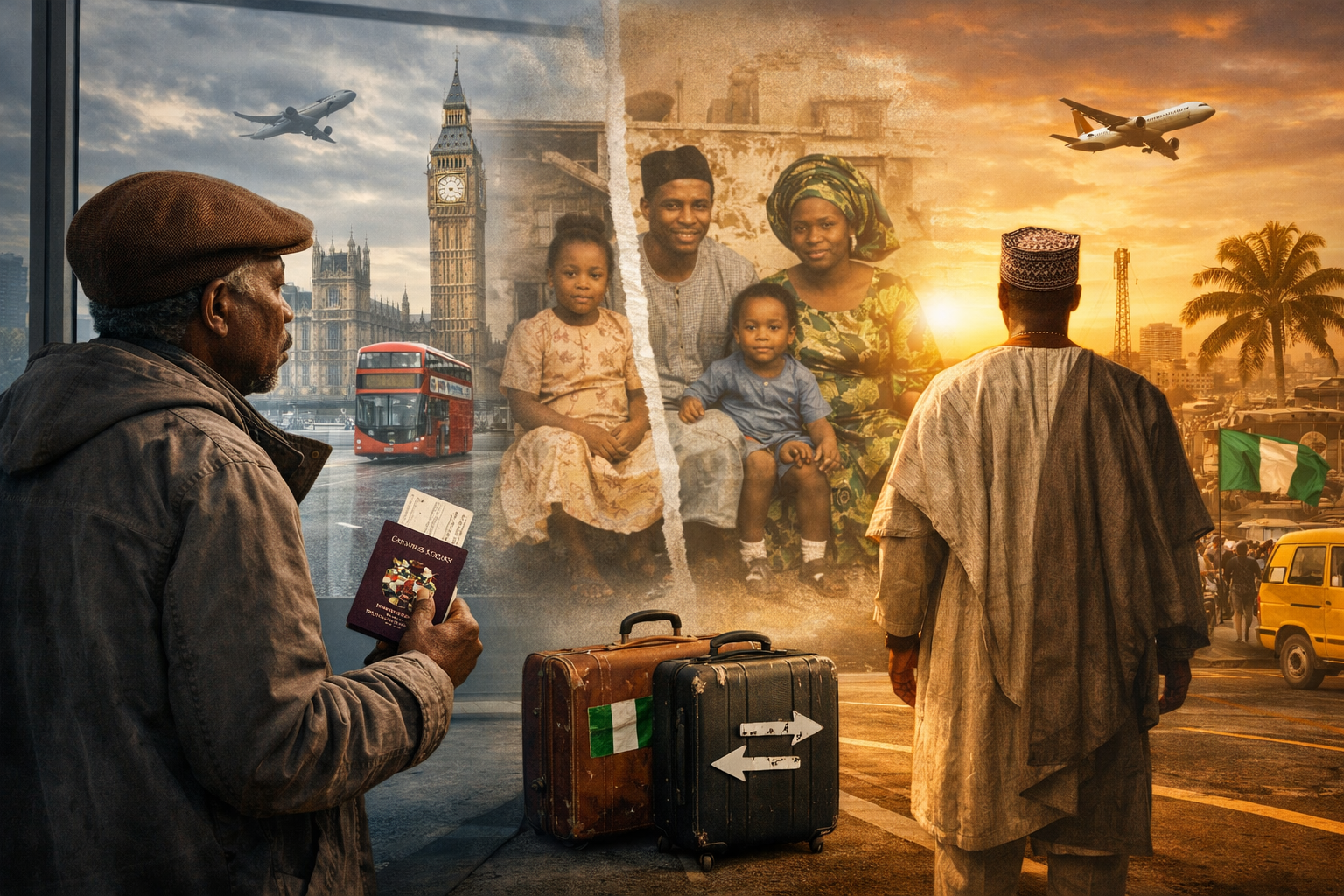
Japada!!!!!!
Thought Provoking Looong Piece Vividly Elaborating the Absolute 💯 TRUTH…
99.9 percent of people in the diaspora would like to relocate back to Nigeria, but they can’t, or they won’t. I know friends of mine who arrived in England in 1983, and from the very year they arrived, all they talked about was going back home. Almost four decades later, they are still in England. I also know people who went back to Nigeria and then returned to the Western world after a 30-year absence.
Before you get fully indulged in this article, ask yourself one simple question. How many of your friends have japada, lock, stock, and barrel, and actually become successful in Nigeria?
There are three types of Japada.
First, Japada by deportation.
This one is the saddest. People get deported due to their papers. The painful part is that when these diasporas are deported, the same people back home they have been sending money to are often the same ones who mock them on arrival.
Second, relocating back after studies.
This used to be common in the 70s and 80s, but it is no longer the case today.
Third, old age relocation.
This usually happens after decades abroad, when most life goals have been achieved, such as starting a family, raising children, and watching them eventually fly away from the nest.
Diaspora Wives
Most diaspora wives have no intention of leaving the Western world, and they have valid reasons. They want to stay close to their children and grandchildren. They are used to Western infrastructure and cannot do without it. Good roads, constant electricity, steady water supply, security, justice, proper education, and a functioning healthcare system.
These women do not want to gamble with their health. They fear being treated by unqualified doctors or consuming fake drugs. They understand that old age is when you need the best medical care. While diaspora wives are not prepared to downgrade, their husbands are often ready to downgrade to bad roads, diesel smoke, and endless frustrations.
Diaspora Husbands
Most diaspora husbands want to relocate back home. I could easily write a whole book about them. Where do I even start?
Let’s go back to their early years abroad. We must understand that their idea of marriage, formed during their teenage years, is completely different from what they experience in the Western world.
As boys growing up, they watched their mothers pamper and obey their fathers. In return, they grew up expecting the same hospitality from their wives. But the Western world does not leave room for that. Long working hours and demanding schedules remove that possibility. These men spend their entire lives wishing for the same attention and care their fathers received from their mothers.
These men are risk takers. They constantly look toward Nigeria as a place to invest, either by starting a business or buying land to build property. Their first investment usually begins while they are still living abroad. In most cases, if not all, those businesses fail.
These failures happen for several reasons.
First reason.
This one has nothing to do with Nigeria. Imagine a government worker of 20 years, with zero business experience, taking a loan to start a business in Nigeria. That business is almost guaranteed to fail because the person lacks business knowledge.
Second reason.
They try to run a Nigerian business the same way businesses are run in the Western world. It does not work that way in Nigeria.
Third reason.
They choose a local friend or family member who is corrupt or untrustworthy as a partner. Both the diaspora and those left behind often fail to understand one thing: we are no longer the same. Our thinking has changed. This does not mean one is better than the other. It simply means we see things differently.
Fourth reason.
This one is closer to home, their wives. Once these men explain their business plans to their wives, the wives’ sixth sense kicks in. They immediately sense it will not work, and in most cases, they are right.
After the Children Have Left
Diaspora wives continue their lives by following their children and grandchildren, while the husband slowly becomes surplus to requirements. It is at this stage that the husband begins to seriously consider relocating back to Nigeria.
He starts visiting Nigeria more frequently. His motherland, where everyone looks like him. His language and accent blend in effortlessly. With his pension, everything feels cheap. Eating out, partying, drinking, even maintaining a 20-year-old side chick.
If his doctor has not already prescribed Viagra or Cialis due to an enlarged prostate, he will happily turn to herbs soaked in alcohol in Nigeria, opa eyin. Meanwhile, the wife remains in the Western world, looking after grandchildren and believing she still has a husband. In reality, that marriage has already ended. The husband has fallen in love with a side chick and started a new family without the wife’s knowledge.
This situation is becoming very common.
A very good friend of mine, who I refer to as bros, was 64 years old when he began visiting Nigeria while his wife stayed behind. In 2020, he called me in Atlanta and said he had good news. When I asked what the good news was, he told me his side chick in Nigeria had just given birth to triplets.
I nearly fell off my chair while eating breakfast. I had no idea she was even pregnant.
I waited a few weeks before calling him back. I asked if he believed this was the right decision and if he was not too old to start a new family at 64. He told me my thinking was too Western. According to him, he did not need to raise the children. All he needed to do was provide money. A roof over their heads, food on the table, a driver, a gateman, a chef, school fees, and after-school teachers.
After that conversation, it became clear to me that he had chosen to live the same life as our fathers. Despite living abroad for four decades, he returned to the same desires he had from day one. The Western world never removed those desires; it only delayed them.
Atlanta Diaspora Husbands Friday Night Out
In 2015, when I relocated to Atlanta, Georgia, a friend invited me out one Friday night for what he called a boys’ night out. The venue was a rooftop bar at one of the downtown high-rise hotels.
When I arrived, about 15 to 20 Nigerian men were already there. It was a relaxed and classy evening. The age range was wide, from early 30s to a man who had to be in his 70s. Their professions covered everything imaginable: entrepreneurs, limousine drivers, IT consultants, teachers, doctors, surgeons, lawyers, and more.
The setup was simple. You sit, order food and drink, then move to the bar. People sipped cognac and champagne, smoked cigars, and talked. That was where the real entertainment began.
Almost all the conversation revolved around women. About 80 percent was about wives at home, while the remaining 20 percent focused on side relationships.
The men were seriously lamenting. They spoke about the high cost of raising families, lack of intimacy at home, wives going through menopause, wives no longer cooking, and constant household struggles. Every man had a story.
Then an elderly man, who had been quiet all night, cleared his throat. He must have been in his 70s. He said he had advice for everyone.
He said the two main reasons many of them were unhappy at home, apart from money, were food and sex. Many men nodded.
He said, if your wife no longer cooks, you all have jobs and extra money. Instead of fighting at home, stop at a restaurant after work. Eat Nigerian food, Chinese food, Mexican food, anywhere. Either eat there or take it home. While you are there, call your wife and ask what she wants. When you both eat, peace returns.
Then he addressed intimacy. He said your wife is tired, going through menopause, or dealing with hormonal changes, and you are frustrated. Then he shocked the room.
He said, stop at a strip joint, enjoy yourself, then go home.
The room went silent. He ended by saying this was how to keep a family together in the Western world.
The Sad End
The price we pay as members of the diaspora is rarely discussed. No matter how hard you try to blend in, you are never fully accepted. You can change your looks, your dressing, even your accent. Still, at the end of the day, you are seen as that Black man from Africa.
Among white people, you are Black first. Among African Americans, you are African first. The line never disappears.
As we age, fear sets in. What happens in old age? Not everyone remains healthy. Many will need care, and the children raised in the Western world are not culturally conditioned to care for their parents. They are taught independence. Care homes become the solution.
Even food becomes punishment. After decades of Nigerian meals, you are left with potatoes, broccoli, carrots, and unseasoned chicken. That alone feels like exile.
We try to pass our culture to our children, but maybe only 40 percent remains. With grandchildren, even less. Eventually, only a name survives. The culture fades.
I used to say that if Nigeria was good, we would never have left in the first place. The Nigeria I left in 1983 was better than what exists today. I no longer blame Nigeria the same way.
Instead, I ask a painful question.
Are Black people cursed?
Let me begin with the slave trade. About 12 million Africans were taken into slavery. Have you ever asked why it was white people who enslaved us, and not the other way around? Does that mean they were cleverer than us? The uncomfortable truth is that we cannot place all the blame on white people, because our own forefathers sold our people.
Now fast-forward to 2026. The Nigerians in Diaspora Commission, NIDCOM, says about 20 million Nigerians are living abroad. Yes, 20 million. To put that into context, look at the population of our neighbouring countries. Cameroon has about 30 million people, Ghana has about 32 million, the Republic of Benin has about 14 million, and Togo has about 9 million. The population that I quoted for our neighbouring countries are the population of those in their country not the ones that has left. The slave trade is long gone, yet we are still the ones fleeing our own fatherlands.
When you look across Africa, all 54 countries, you will struggle to name even five that are properly run. A large percentage of Africans are still living in poverty. What our people call poverty is very different from what the Western world calls poverty. Many Nigerians think poverty means begging by the roadside, but the real truth is that living in a country without infrastructure is poverty.
And for Black people living in the USA and the UK, racism is still very much present, even though the slave trade was abolished over 160 years ago.
In all my 48 years as a diaspora, I can only speak from what I have seen, heard, and lived through. Out of all my 32 friends who relocated back to Nigeria over the years, only four truly relocated home, lock, stock, and barrel, and became genuinely successful. By successful, I do not just mean owning property or driving flashy cars, but building something stable, sustainable, and rooted in Nigeria. The rest of them, in one way or another, always find themselves running back to the Western world.
Many people in the diaspora talk loudly about going back home. They make plans, they buy land, they build houses, and they announce their return with excitement. But when reality sets in, most of them cannot fully cut ties with the West. The truth is that relocating back home is not as simple as boarding a plane with good intentions. Nigeria tests you in ways that only those who have tried to live there long-term will truly understand.
One scenario I witnessed recently sums it all up. A Nigerian relocated back home but still comes back to work in the USA. On paper, he looks like a success story. He owns his own house in Nigeria and has staff who run the household. From the outside, it appears that he has made it. Yet the reality is different. He is a truck driver in America. He works for three months straight, driving trucks across the United States, sleeping in truck stops, enduring long hours on the road. After three months, he returns to Nigeria to rest for another three months, before going back to America again to repeat the same cycle.
So the question is, has he really relocated? Or has he simply created a survival arrangement between two worlds? This is the pattern for many in the diaspora. Nigeria becomes a place to rest, while the Western world remains the place to earn. Emotionally, their heart is at home, but financially, their lifeline is still abroad.
This back-and-forth life takes its toll. You are never fully settled anywhere. In the West, you are working relentlessly, counting down the days until you can leave again. Back home, you are always aware that the money you are spending was earned elsewhere, and that soon you must return to replenish it. It becomes a cycle, not a destination.
The few friends I know who truly succeeded after relocating back home did something different. They committed fully. They accepted the frustrations, the inefficiencies, the disappointments, and the sacrifices that come with living and doing business in Nigeria. Furthermore, they did not keep one foot in the West and one foot at home. Besides, they stayed, struggled, adapted, and eventually found their footing. That kind of success is rare because it demands patience, resilience, and a strong support system.
Many diasporas underestimate how comfortable life in the West has made them. Constant electricity, functional systems, predictable income, and basic security become things you only appreciate once they are gone. Back home, you must fight for almost everything, from power to paperwork. Not everyone has the mental strength or financial buffer to endure that long enough to succeed.
This is why so many people return to the Western world, quietly or loudly. Some admit defeat openly, others disguise it by calling it “business travel” or “temporary work.” But the truth remains. Fully relocating back home is one of the hardest decisions a diaspora can make, and only a few see it through to the end.
Ultimately, everyone must choose their own path. There is no shame in doing what works for you. But we must be honest with ourselves and with others. Visiting Nigeria is not the same as relocating. Owning a house is not the same as building a life. Until you can live, earn, and survive fully at home, without running back to the West, the journey is still unfinished.