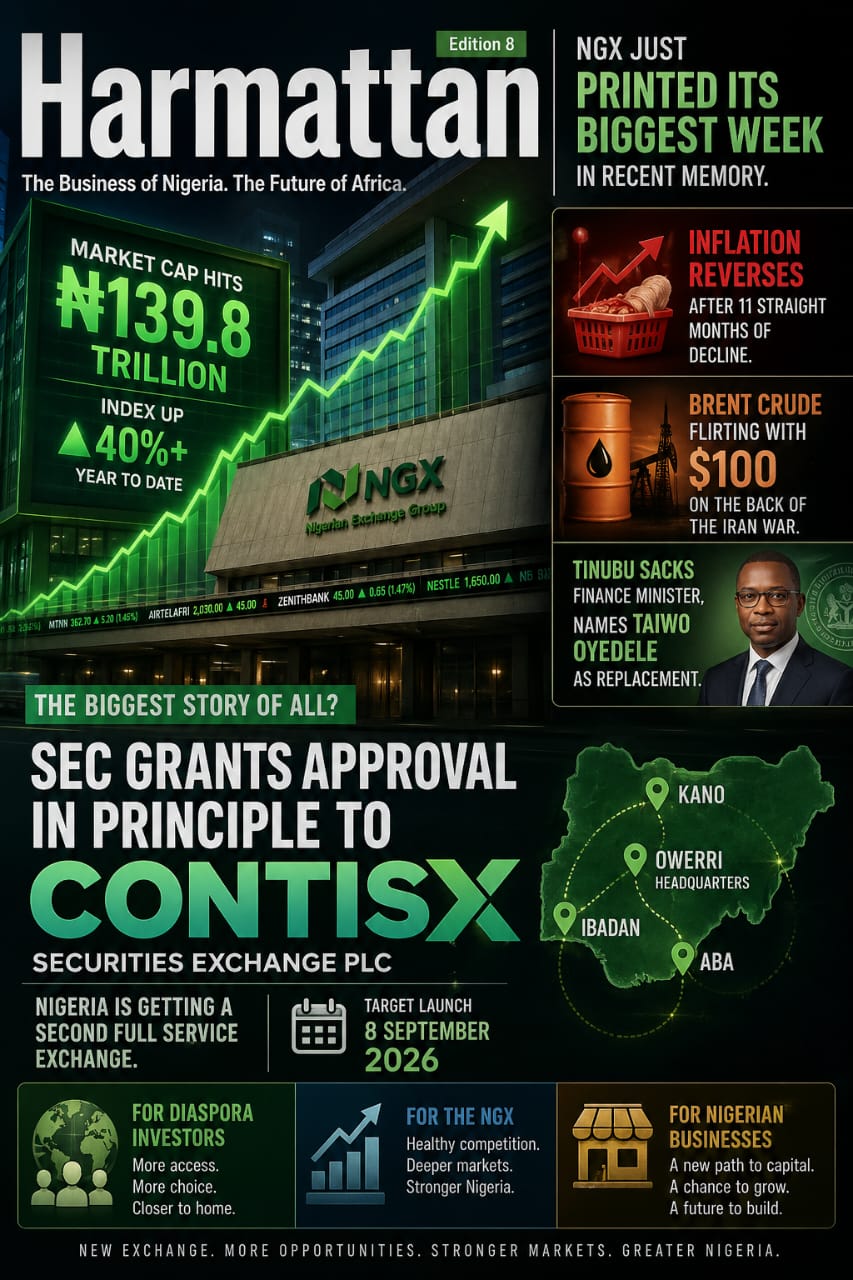
The week ended Friday 17 April was the strongest in recent memory. The NGX All-Share Index rose 6.20 percent in five consecutive positive sessions, adding 12,679 points and lifting market capitalisation by ₦8.89 trillion to ₦139.8 trillion. Turnover climbed to 3.588 billion shares worth ₦195.3 billion across 254,553 deals. Breadth was constructive, with 61 gainers against 36 losers. The Banking Index surged 11.85 percent on the continuing recapitalisation story, with ₦4.65 trillion raised sector-wide ahead of the 31 March deadline. The Oil and Gas Index climbed 17.59 percent. Premium names led the board, with First Holdco up 22.96 percent, Access Holdings up 15 percent, Zenith up 12.50 percent, MTN up 10.74 percent, and Seplat up 9.42 percent.
₦139.8 trillion. Nigerian equities have never been worth more, and the investors driving that number are betting the story is far from finished.
By Tuesday 21 April, the picture grew more complicated. The index edged up a further 0.06 percent to close at 218,249.81 and extend year-to-date gains to 40.25 percent, but breadth inverted to 25 gainers against 43 decliners. Volume dropped 14 percent and turnover fell 12 percent. Previous leaders including Stanbic IBTC and Access Holdings appeared among the biggest decliners. Analysts now expect consolidation in a 212,000 to 218,000 range as first quarter earnings season approaches.
The Big Story
The most significant development of the past seven days was not a price move. On Monday 20 April, the Securities and Exchange Commission granted Approval-in-Principle to ContisX Securities Exchange Plc, clearing the way for Nigeria to have its first full-service equities exchange operating alongside the Nigerian Exchange in the market’s modern history. Founded by Professor Ndubuisi Ekekwe, a Johns Hopkins-trained engineer, TED Fellow, and former World Economic Forum Young Global Leader, ContisX is targeting a launch on 8 September 2026, with its headquarters in Owerri and regional hubs planned for Aba, Kano, and Ibadan. This is not a minor listing platform. It is being built as a multi-asset exchange for equities, bonds, commercial paper, derivatives, and exchange-traded funds, with explicit ambitions to serve cooperatives, subnational governments, diaspora capital, and the long tail of Nigerian enterprises that the NGX has never comfortably accommodated.
The strategic logic deserves careful attention. Nigeria’s equities market has long concentrated liquidity in a handful of counters, leaving capital formation for small and medium businesses dependent on banks, private equity, and informal arrangements. Professor Ekekwe frames the opportunity around what he calls investment inclusion. Roughly five trillion naira of currency circulates outside the formal banking system, earning nothing. If even half of that were channelled into simple sovereign instruments at ten percent, citizens would earn around two hundred and fifty billion naira annually while the government gained a domestic capital pool to finance development. The deeper thesis is that Nigeria is not capital-short. Nigeria is capital-immobilised. A second exchange, properly designed, could shift that equation.
For diaspora investors and institutional allocators, this matters for three reasons. First, competition tends to sharpen incumbents. A credible parallel exchange should pressure the NGX on listing costs, settlement speed, and product innovation in ways that purely internal reform rarely delivers. Second, the decentralised geographic footprint is unprecedented. An exchange headquartered in Owerri with hubs in Aba, Kano, and Ibadan is a deliberate statement that capital markets should reach where economic activity actually happens rather than concentrate entirely in Lagos. Third, the diaspora engagement strategy is explicit, with Professor Ekekwe publicly inviting Nigerians abroad under the banner “Invest at Home, Thrive Globally” and confirming engagement visits to North America in the coming months. Harmattan will track ContisX closely from here, including through the remaining licence conditions and the September launch window, because if the exchange delivers on even half its ambition the architecture of African capital markets shifts in a direction that has been needed for decades. Approval-in-Principle is not a full operating licence, and execution risk is real, but for the first time the conversation has moved beyond theory.
Nigeria’s Money
While the equity rally dominated headlines, the National Bureau of Statistics published data on 15 April that reframes the domestic story. Headline inflation rose to 15.38 percent in March from 15.06 percent in February, the first monthly increase in a year and the end of an eleven-month disinflation trend that had taken prices down from 27.35 percent twelve months earlier. Month-on-month inflation more than doubled to 4.18 percent from 2.01 percent. The drivers are largely imported, with transport inflation jumping to 16.9 percent and core inflation rising to 16.21 percent as oil prices feed through. Rural inflation at 17.22 percent now sits well above urban inflation of 14.64 percent.
This is where the gap between formal markets and real Nigerian life becomes painfully visible. The same seven days that delivered record equity gains delivered an inflation reversal that falls hardest on households without access to capital markets. The Central Bank’s ambition to anchor inflation toward single digits in 2026 has just become materially harder, and the next Monetary Policy Committee meeting on 19 and 20 May will almost certainly hold the benchmark rate at 26.50 percent rather than extend February’s cut. For the millions of Nigerians whose savings sit in cash or cooperative arrangements rather than in listed securities, the gains on the NGX are a story they read about, not one they participate in. ContisX, if it succeeds, is among the few structural answers being built to that problem.
Africa Watch
Beyond Nigeria, the International Monetary Fund published its April World Economic Outlook during Spring Meetings week in Washington, downgrading sub-Saharan Africa’s 2026 growth projection and lifting the region’s median inflation forecast from 3.4 percent to 5 percent on the back of the war-driven oil and fertiliser shock. Nigeria specifically saw its 2026 GDP growth projection trimmed to 4.1 percent from 4.4 percent. The broader implication for African sovereign issuers is that the window of favourable Eurobond conditions that opened in the first quarter, and which the Democratic Republic of the Congo stepped through with its debut issuance, may be closing faster than expected. Countries with pending issuance plans, including Ghana’s anticipated post-restructuring return to international capital markets, now face a materially less forgiving environment.
What to Watch
Two developments deserve close attention over the coming seven days. The first is the arrival of first quarter 2026 bank earnings. Tier-one lenders posted combined after-tax profit of ₦2.49 trillion in the first nine months of 2025, down from ₦3.07 trillion a year earlier as foreign exchange revaluation gains reversed. If GTCO, Zenith, and Access confirm that contraction extending into the first quarter, the banking-led rally will require a fundamental reassessment. The second is any early public signal from Taiwo Oyedele, newly appointed Minister of Finance, on revenue execution and the fate of the undisbursed capital allocations from the 2025 budget. Markets will read his first fortnight carefully for continuity on the tax reform architecture he designed in his prior role, and for any indication of how the presidency intends to manage fiscal policy through a pre-election year.
Records get made for a reason, and records get tested for a reason too. The past seven days have given Nigeria both. What comes next depends less on the index and more on whether the institutions quietly being built beneath it, from a recapitalised banking sector to a second securities exchange, are allowed the time they need to deliver.
Nothing published in Harmattan constitutes financial advice. Always consult a qualified financial adviser before making investment decisions.
— Bestman Eleanya